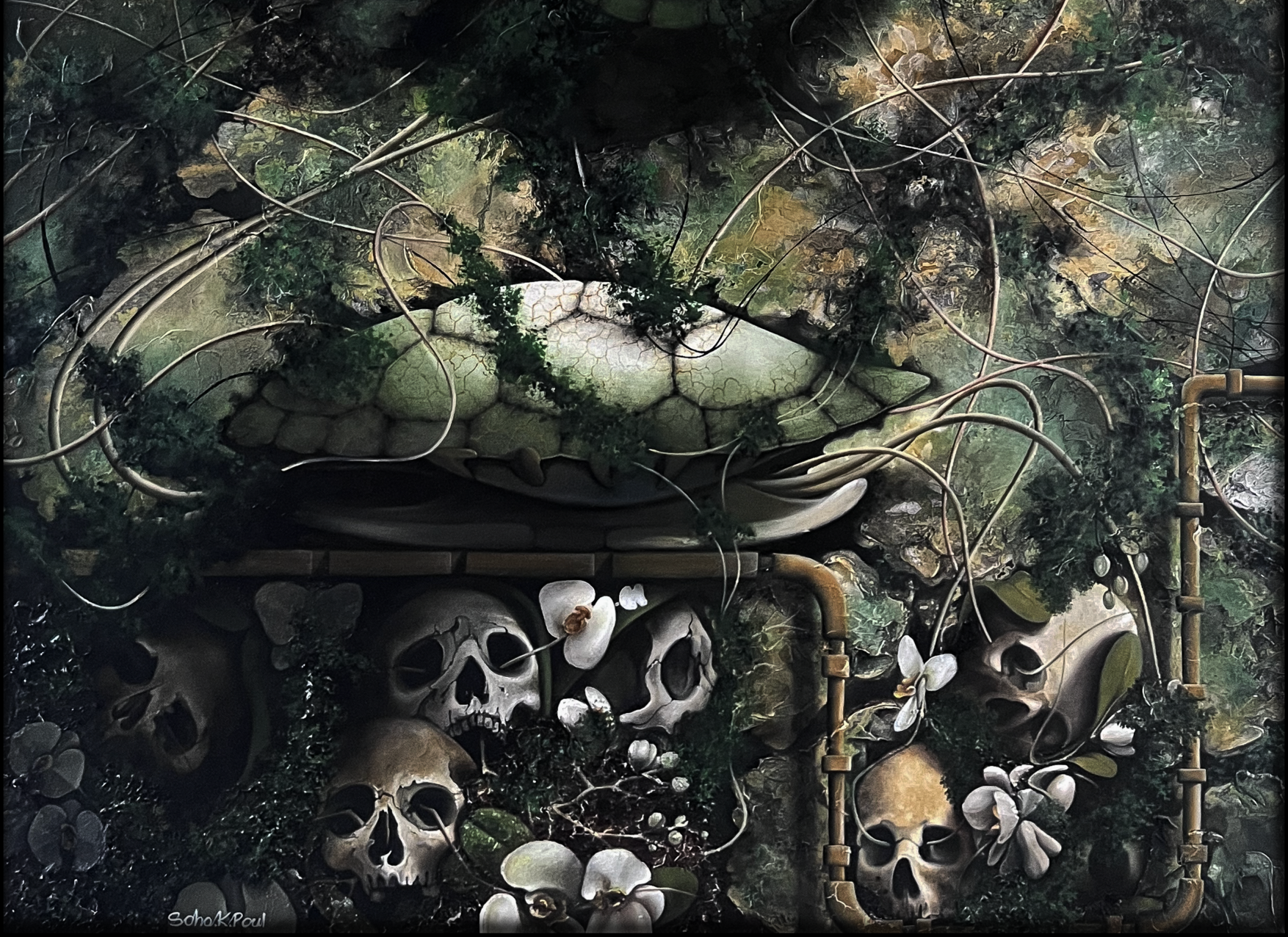
After Destruction, Life
On decay, regeneration, and the strange continuity of life beyond endings. We often imagine
Beyond the Visible: Meaning Through Oil Painting
language.
Painting, for me, has never been simply about reproducing what I see. The visible world is often only the beginning. A landscape, a fragment of nature, an object, a shadow, or an ordinary moment can contain something far more complex than its immediate appearance. I am interested in looking beyond that first layer, allowing observation, memory and imagination to alter what is familiar until another meaning begins to emerge. Oil painting gives me the time and material depth to explore this transformation. Unlike an immediate image, a painting develops slowly. Layers are added, obscured, removed and rebuilt. Colours shift against one another. Forms disappear beneath the surface and return in unexpected ways. The image becomes less about recording a moment and more about constructing a psychological space.
Surrealism has always interested me because it allows reality to remain recognisable while freeing it from its expected logic. I am not interested in fantasy simply for the sake of creating something strange. What attracts me is the possibility of taking something familiar and changing its context, scale, relationship or atmosphere until it begins to reveal another emotional reality. A natural form can become architectural. A body can dissolve into a landscape. An ordinary object can become monumental. A quiet scene can carry an unexpected sense of tension. These transformations create a space between what we know and what we feel.For me, this is where surrealism becomes particularly powerful. It does not necessarily require an entirely invented world. Sometimes a slight displacement of reality is enough to make us question the way we originally understood it.
Abstraction enters my work differently.Where surrealism often transforms recognisable forms, abstraction allows me to move further away from representation and concentrate on relationships: colour against colour, density against emptiness, movement against stillness, light against shadow. In this sense, abstraction is not an escape from reality. It can be a way of examining reality more closely. When the identity of an object disappears, other qualities become more visible. Texture becomes landscape. A line becomes movement. Colour begins to carry emotional weight. A surface can suggest distance, memory or atmosphere without depicting any specific place. The viewer is no longer told exactly what to see. Instead, the work creates a space in which perception can remain open.
Oil paint is particularly important to this process because of its physicality. It can be transparent or opaque, controlled or unpredictable. A surface can remain almost silent in one area and become heavily worked in another. Layers can preserve traces of earlier decisions beneath the final image. I am fascinated by this accumulation. A painting contains its own history. Even when earlier marks are covered, something of them remains within the surface. For me, this resembles the way memory operates: experiences accumulate, overlap and sometimes disappear from immediate view without completely leaving us. This is one reason I rarely think of a painting as a single image. I think of it as a constructed field of time, material and perception.
Much of my work begins with observation. I am interested in things that can easily be overlooked: the structure of bark, mist moving through a landscape, the shape created by a shadow, weathered surfaces, fragments of the human body, or unexpected geometries found in nature. The subject itself does not need to be extraordinary. The act of looking can make it extraordinary. There is a difference between seeing something and truly observing it. The longer I look, the less stable familiar things become. New forms appear. Associations develop. Reality begins to overlap with memory and imagination. Painting allows me to remain inside that process. I can take an observation from the physical world and gradually remove it from certainty.
I do not want every element of a painting to have one fixed interpretation. Meaning becomes more interesting when it is discovered rather than explained. A work may begin with a very personal thought, memory or observation, but once it exists independently, the viewer brings another history to it. The same colour, form or atmosphere can create completely different associations in different people. That ambiguity is important to me. I want the work to contain enough familiarity to invite the viewer in, but enough uncertainty to make them stay. This is where surrealism and abstraction begin to overlap within my practice. One disturbs the logic of the visible world; the other removes parts of that world entirely. Both create room for imagination.
Ultimately, my paintings are not attempts to reproduce reality. They are attempts to reconsider it. I use oil paint, surreal transformation and abstraction as different ways of moving beyond immediate appearances — searching for the emotional, psychological and sometimes spatial qualities hidden beneath what we encounter every day. The world around us is already filled with strange relationships, accidental compositions and forms that exist somewhere between the familiar and the unknown. Sometimes art does not need to invent another world. It only needs to make us look at this one differently.
Soha K. Poul
Artist & Chartered Architect
Other
On decay, regeneration, and the strange continuity of life beyond endings. We often imagine
On traces, time, and the human desire to leave something behind. There are walls that
An exploration of the human presence hidden within trees, and the moment observation begins to